Student life can feel like a series of demands: finish the assignment, answer the message, prepare for the examination, decide what comes next. Rajyoga meditation for students offers a way to make room for reflection within that busy day. The starting point is a small, deliberate pause in which you notice your thoughts and choose the attitude you want to bring to your next task.
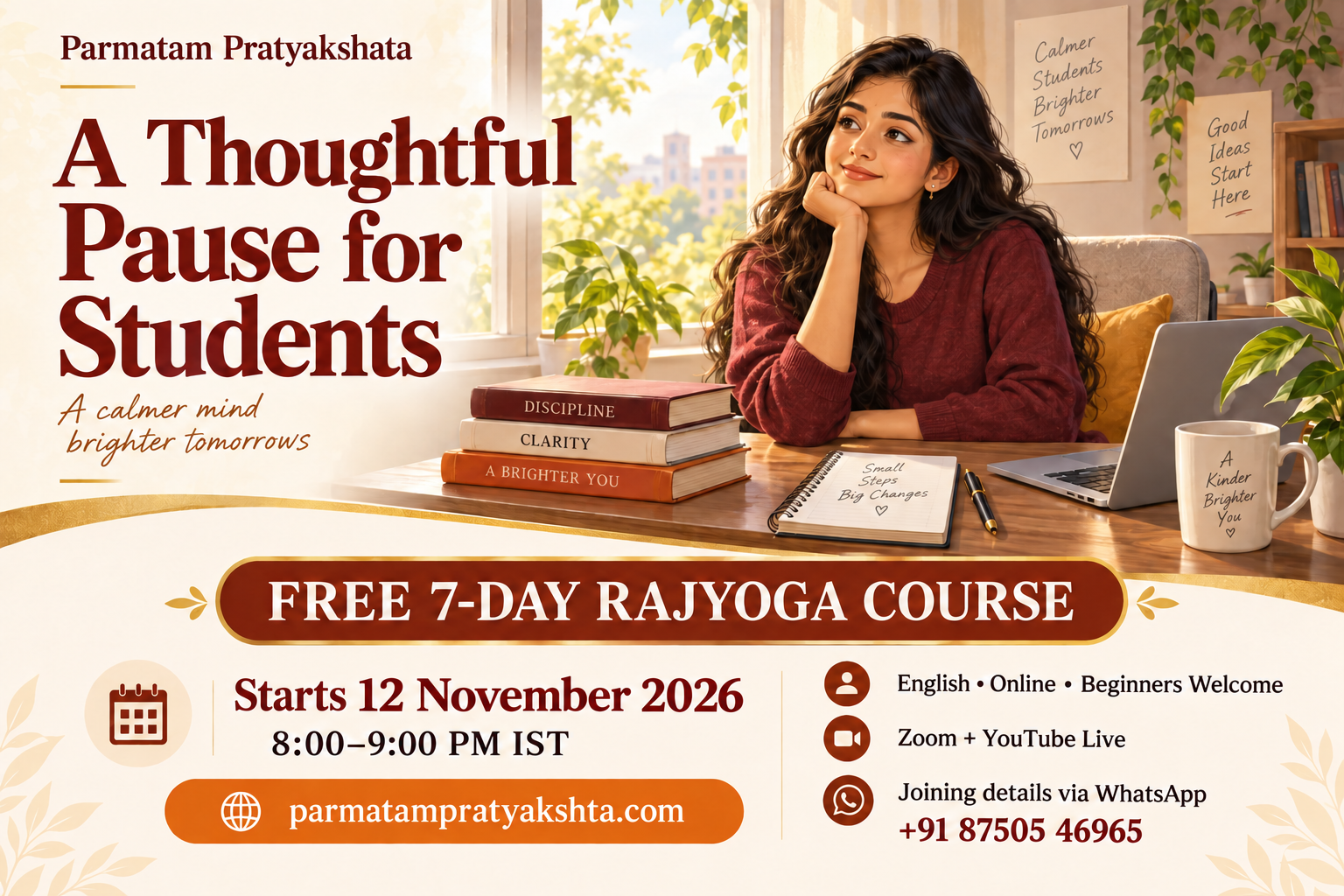
This guide offers practical reflection ideas for college students and adult learners. They are suggestions to explore, rather than promises about examination results. For guided learning, the free English course starts on 12 November 2026 at 8:00 PM IST.
Begin with one manageable pause
A useful moment to practise is the transition between activities. Before opening your notes, sit comfortably and put the phone aside. Let your eyes rest naturally on a simple point in front of you. There is no need to force concentration or create an unusual experience. Notice what is already occupying your attention.
You might discover a practical concern, such as an unfinished chapter, or a judgement, such as feeling behind everyone else. Name it quietly. Then choose a realistic thought: “I can give this next task my attention.” Open the book and decide on one concrete action, such as reading two pages or outlining a paragraph. Keep the reflection brief enough that you actually use it.
Understand the Rajyoga perspective
In the Brahma Kumaris tradition, Rajyoga is an open-eyed spiritual practice involving awareness of the self as a soul and connection with the Supreme Soul. The official introduction to Raja Yoga explains its emphasis on reflection and the quality of thoughts. This spiritual understanding is the context for the course.
For a student, an everyday reflection could be that a grade describes one piece of work, while your worth is larger than that result. Take responsibility for preparation and feedback without turning every setback into a definition of yourself. You can explore the teaching gradually and ask questions when a concept is unfamiliar.
Fit practice around an actual student schedule
Start with the timetable you already have. A routine that requires a perfect morning, a private room and an empty calendar is unlikely to last during a busy term. Choose a reliable cue: arriving at your desk, finishing lunch or closing your laptop. Attach a short reflection to that cue instead of adding a demanding new project.
- Before studying: decide what you will work on and which quality you want to practise, such as patience.
- Between tasks: notice whether you are carrying frustration from the previous activity.
- After studying: record one completed action and one sensible next step.
These are optional personal exercises, not the announced daily syllabus of the seven-day course. If a day becomes crowded, use the smallest version: one quiet moment and one clear intention. A missed pause is a reason to restart at the next opportunity, rather than abandon the whole routine.
Work with comparison without feeding it
Imagine seeing a classmate post that their revision is complete. Before reorganising your entire evening in a panic, separate the facts from your assumptions. You know what they posted; you do not know the full story of their preparation. Return to your own task list and choose the most useful next action.
A reflection notebook can have three simple columns: situation, first thought and considered response. For example: “A friend finished early; I thought I was failing; I chose to review my own plan.” This gives you something specific to reflect on without pretending that uncomfortable thoughts must disappear.
Give online learning your attention
For the evening course, reserve the full 8:00 PM–9:00 PM IST session where possible. Check how it fits around meals, classes or work. Keep one notebook nearby and write short questions rather than attempting to transcribe every sentence. Close unrelated tabs and use the joining instructions shared by the organisers.
After class, choose one idea to consider during the following day. You might notice how you speak to yourself when a task is difficult, or how quickly you switch to checking your phone. Treat these observations as information. Meditation does not replace studying, sleeping adequately, seeking academic help or asking for support when you need it.
If you share your room with another student, agree on a practical arrangement for the evening class. Headphones and a clear start time may be enough. Keep your expectations modest: attend, listen and write one useful question. The next day, return to your study responsibilities with a specific plan.
Student questions
Do I need meditation experience?
No. Beginners are welcome in the course. Bring curiosity and a willingness to ask about ideas you do not yet understand.
Will this guarantee better marks?
No result is guaranteed. This is spiritual learning and reflection. Academic progress still depends on preparation, teaching, circumstances and other factors.
Where can I learn the basic practice first?
Read our open-eye Rajyoga meditation guide, then use the live course to explore questions with the organisers.
Join the free course on 12 November 2026
The next free 7-day Rajyoga meditation course in English begins on Thursday, 12 November 2026. Beginners are welcome. Keep the following details handy when planning your week.
- Time: 8:00 PM–9:00 PM IST.
- Duration: Seven days.
- Language: English.
- Fee: Free.
- Format: Online, with Zoom as the main classroom and YouTube Live details shared through the WhatsApp group.
Join the course WhatsApp group
Open the invitation for Learn Rajyoga Meditation in English (November 2026) and check the group updates for access links. Save the session time in your calendar; if you live outside India, convert from IST before attending.
For course enquiries, contact +91 87505 46965 on WhatsApp or email hiteshchhabra91@gmail.com. Read the complete course announcement for the central reference page. Please check with the organisers about recordings or certificates; neither is promised here.
